Is a 24/7 AI Receptionist Worth It for a Small Business?
Short answer: It can be, if you miss calls, especially after hours, and if a new customer is worth more than the monthly cost. Research on speed to lead shows a lead's odds of being contacted and qualified drop sharply within minutes. Voicemail often doesn't catch those callers. An AI receptionist answers straight away, captures the details, and lets you follow up while the enquiry is still warm.

What is a 24/7 AI receptionist?
A 24/7 AI receptionist is a voice assistant that answers your business phone at any hour. Depending on how it's set up, it can:
- Answer common questions (hours, service areas, what you do)
- Take the caller's name, number and what they need
- Book an appointment or request a job, where your calendar allows
- Flag urgent calls for a fast callback
- Send you a summary and transcript straight away
It isn't the same as an old "press 1, press 2" phone menu. It holds a natural conversation. It works best with a narrow, clear job and a fast handoff to a real person.
Speed to lead: why five minutes matters
Speed to lead is how quickly you respond after someone enquires. Two well-known studies looked at it.
The Lead Response Management study was run by Dr James Oldroyd with InsideSales.com (MIT, 2007). It covered 15,000+ web leads and 100,000+ call attempts over three years. It found:
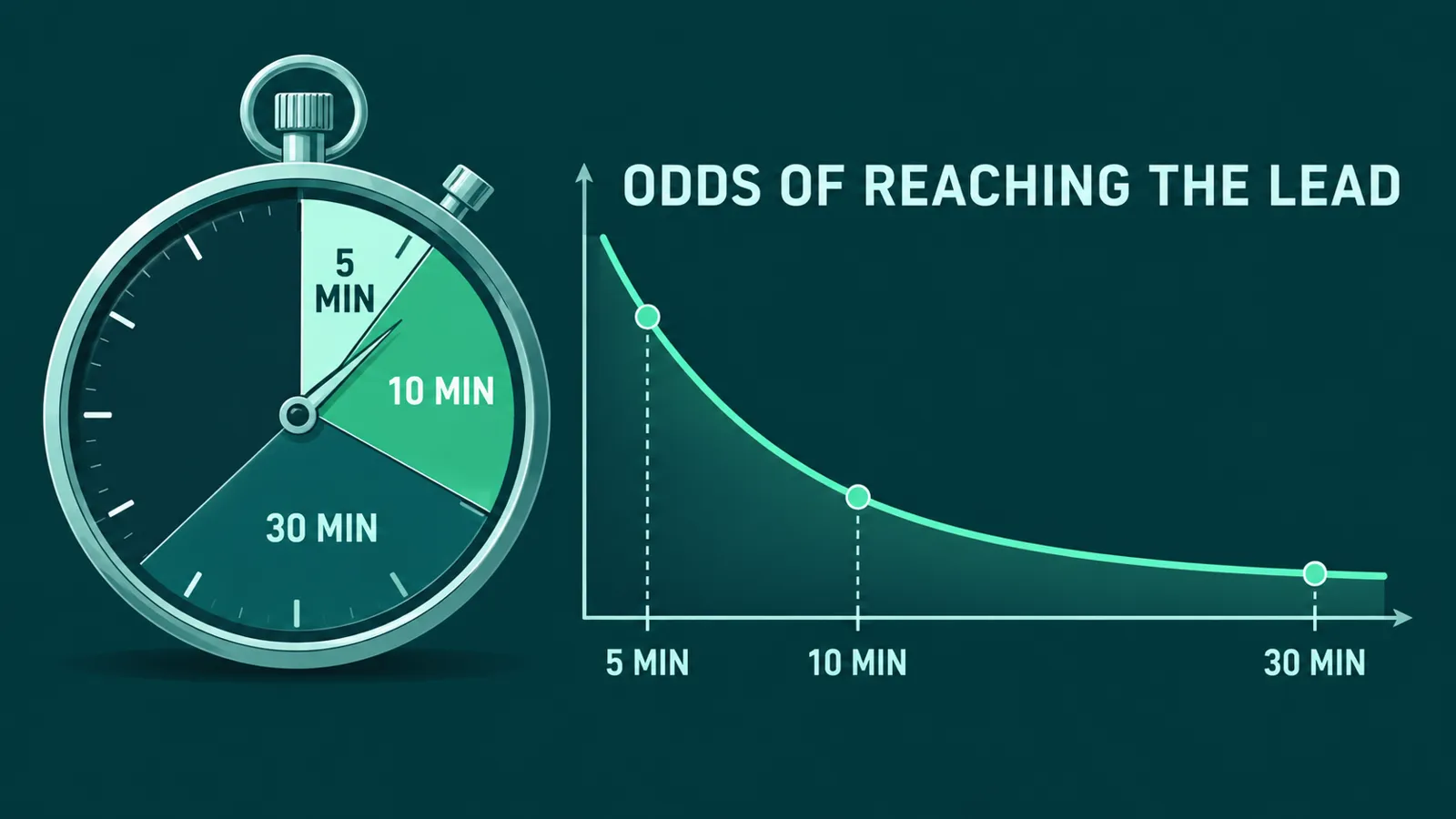
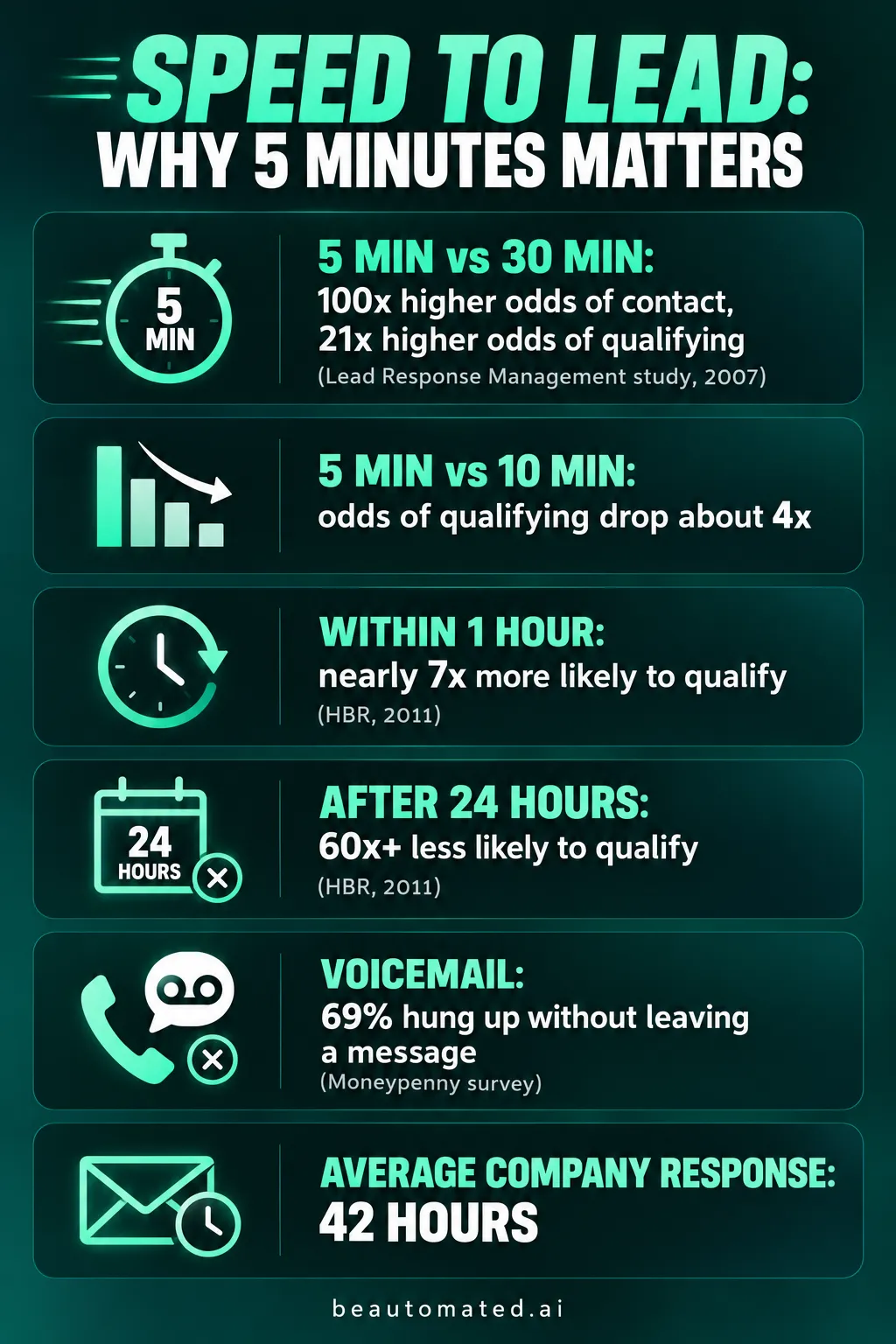
- The odds of contacting a lead called within 5 minutes were about 100 times higher than at 30 minutes.
- The odds of qualifying that lead were about 21 times higher.
- Going from 5 to 10 minutes, the odds of qualifying dropped about 4 times.
- Over the first hour, the odds of contact fell more than 10 times, and the odds of qualifying more than 6 times.
Harvard Business Review, "The Short Life of Online Sales Leads" (2011) looked at 1.25 million leads across 42 US companies. Firms that responded within an hour were nearly 7 times more likely to qualify the lead than firms that waited even an hour longer. They were more than 60 times more likely than firms that waited 24 hours or more.
What happens as the minutes and days pass
| Response time | What the research found | Source |
|---|---|---|
| Within 5 min vs 30 min | ~100x higher odds of contact, ~21x higher odds of qualifying | Lead Response Management study, 2007 |
| 5 min vs 10 min | Odds of qualifying drop ~4x | Lead Response Management study, 2007 |
| First hour | Contact odds fall 10x+, qualifying odds fall 6x+ | Lead Response Management study, 2007 |
| Within 1 hour vs later | ~7x more likely to qualify | HBR, 2011 |
| 24 hours or more | 60x+ less likely to qualify than within an hour | HBR, 2011 |
| A week | No solid published study found | — |
Checked on 31 October 2026.
An honest caveat: both studies measured contacting and qualifying leads, not closed sales. They used US data and are several years old. The direction is clear, though: a faster response generally beats a slower one.
Most businesses are slow. In HBR's audit of 2,241 companies, the average response time was 42 hours, and 23% never responded at all.
AI receptionist vs voicemail
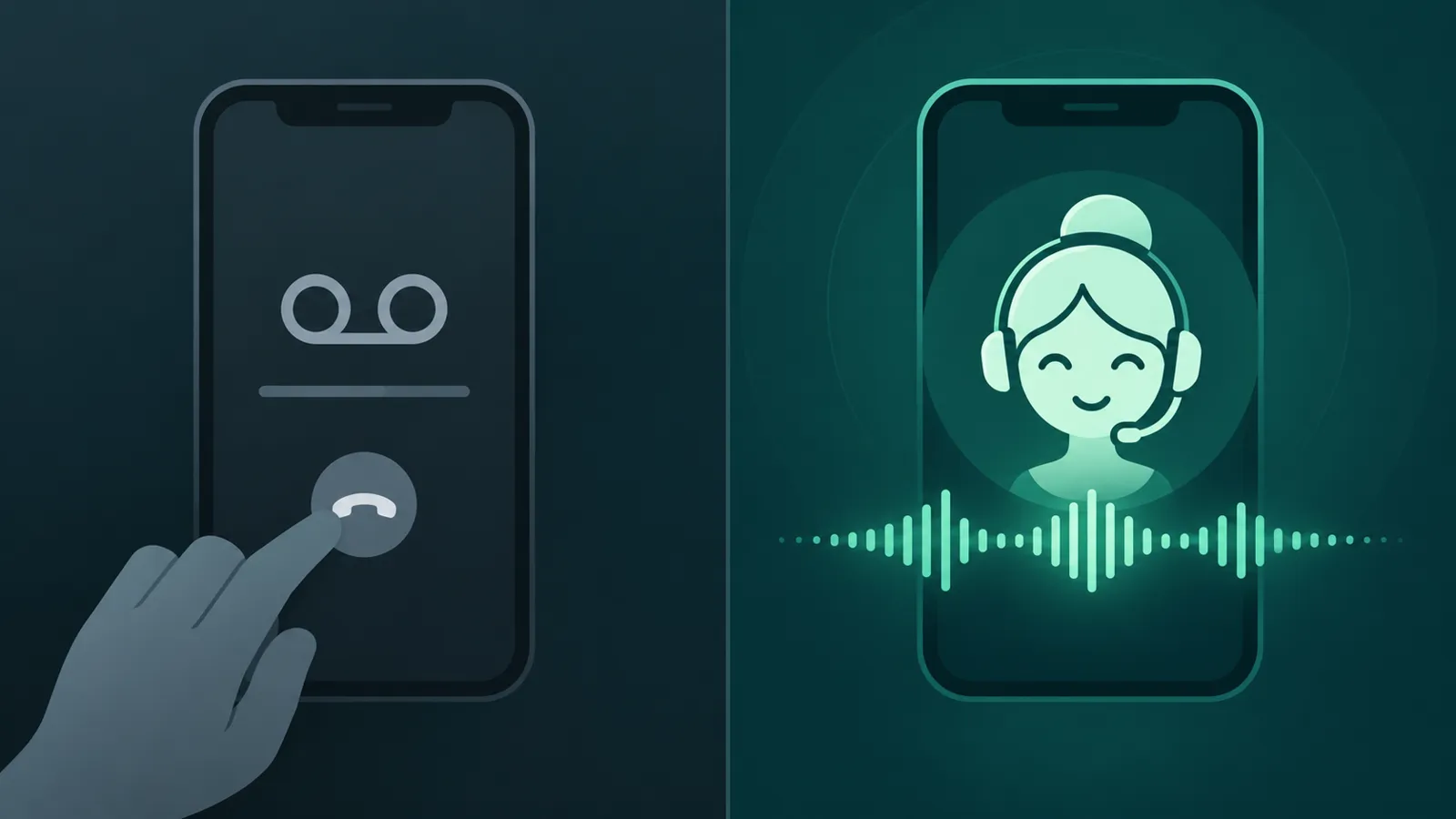
"They'll just leave a message." Often, they don't.
- A Moneypenny small business call report found 69% of callers who reached voicemail hung up without leaving a message.
- Invoca platform data (May 2024) reportedly found fewer than 3% of home-services callers sent to voicemail left a message.
- You'll often see "80% of callers won't leave a voicemail" quoted online. We couldn't trace that figure to an original study, so treat it with caution.
Even when someone does leave a message, you call back later, which puts you at the slow end of the speed-to-lead curve. By then they've often rung the next business.
An AI receptionist answers in a couple of rings and holds a real conversation. It captures the details and sends you the summary right away.
After-hours calls
People call when they have time: early mornings, lunch breaks, evenings and weekends. That's often exactly when you're on a job, with family, or asleep. After hours, a 24/7 AI receptionist can:
- Answer every call instead of letting it ring out
- Take the job details and read them back to check them
- Flag urgent calls for a callback
- Book a time where your calendar allows
For trades, clinics, real estate and any business running ads, evening calls can be some of the most motivated enquiries. Someone with a burst pipe at 9pm isn't waiting until Monday.
How much does an AI receptionist cost in Australia?
These are rough ranges from Australian pricing comparison pages we checked in late October 2026. Prices change, so always check the provider's own page.
| Option | Typical cost (AUD) | Hours covered | Several calls at once? |
|---|---|---|---|
| AI receptionist | About $50 to $600 a month; many entry plans about $100 to $300 | 24/7 | Yes, it can usually answer several calls at the same time without extra staff (limits vary by plan) |
| Human answering service | From about $25 to $33 a month + GST, plus about $2.50 to $3.89 per call | Business hours, with 24/7 on some plans (often extra) | Yes, by having more people on shift |
| Voicemail | Usually included with your phone plan | 24/7, but nobody answers | Takes messages only, and many callers hang up |
| Full-time in-house receptionist | Estimated about $73,000 a year including super | Business hours | One call at a time; more calls means hiring more staff |
One difference that's easy to miss: of these four options, an AI call handler is the only one that can typically answer several calls at the same time without you hiring more staff. That matters when calls bunch up, say after an ad goes out or during a storm. Simultaneous call limits vary by provider and plan, so check yours.
Sources: crmsoftwareaustralia.com.au, findaiconsultants.com.au, vereo.com.au and giday.com.au pricing roundups, checked 31 October 2026.
Things to check before you sign:
- Is it priced per minute or per call?
- Is GST included?
- Is there a setup fee?
- Does it book into your calendar, or only take messages?
- Are after-hours calls charged extra?
- Is there a lock-in contract?
Is it worth it for your business?
- Count your missed calls for two weeks, especially after hours.
- Work out what one new customer is worth to you.
- Compare that with the monthly cost.
- If missed calls are rare, a simpler setup like a missed-call text-back may be enough.
- If you try one, keep it tightly scoped: answer, capture details, book or route, and hand complex or emotional calls to a human fast.
- Test it yourself by calling as your most awkward customer before you switch it on.
The honest truth: an AI receptionist won't fix a slow follow-up process on its own, and nobody can promise more sales. What it can do is make sure the phone gets answered and that you hear about each enquiry while it's still fresh.
Frequently asked questions
What is a 24/7 AI receptionist?
A 24/7 AI receptionist is a voice assistant that answers your business phone day and night. It answers common questions, captures caller details, books or requests jobs, and sends you a summary straight away.
How fast should you respond to a new lead?
As fast as you can, ideally within five minutes. The Lead Response Management study found contact odds were about 100 times higher at five minutes than at thirty, and HBR found responding within an hour was nearly seven times better for qualifying a lead.
Do callers leave voicemails?
Many don't. A Moneypenny survey found 69% of callers sent to voicemail hung up without leaving a message. Popular figures like 80% are widely repeated but hard to trace to an original study.
Is an AI receptionist useful after hours?
Yes. After hours is where it's most useful. It can answer every call, take the details, flag urgent jobs and book times where your calendar allows, so you can follow up first thing or sooner.
How much does an AI receptionist cost in Australia?
From comparison pages we checked in October 2026, Australian AI receptionist plans range from about $50 to $600 a month, and many entry plans sit around $100 to $300. Check minutes, setup fees and GST.
AI receptionist vs answering service: which is better?
Human answering services suit complex or sensitive calls and often charge per call. AI receptionists suit high volume, after-hours and routine calls at a flat monthly price. Many businesses use AI first, with a fast human handoff.
Will callers know they're talking to AI?
Some will. It's good practice for the assistant to say up front that it's an assistant. Callers tend to accept it when it answers quickly, actually helps, and can hand them to a person when they need one.